
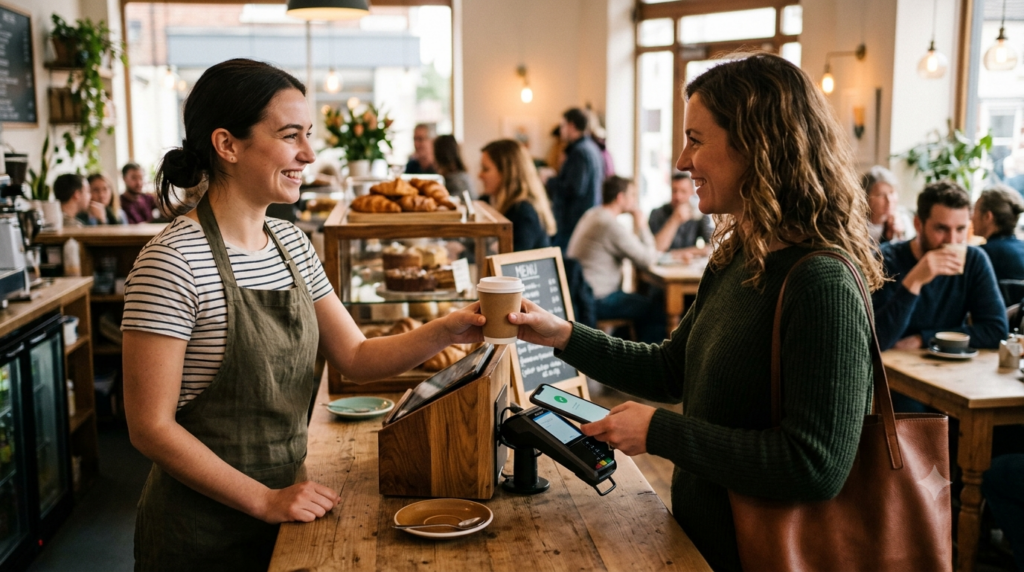
Most merchants never build real customer retention strategies. Here is something worth calculating: of all the customers who walked through your door last month, how many came back this month? By name?
If you cannot answer that question, you are not alone. But you are leaving a significant amount of revenue on the table, and the gap between merchants who grow steadily and those who stay stuck in acquisition mode often comes down to this single blind spot.
A busy checkout is easy to mistake for a healthy business.
Sales are coming in. The payment gateway is processing. Revenue looks fine on paper. But underneath that surface activity, a quieter problem is compounding: most of those customers are strangers, and they will stay that way.
You know someone paid. You know the amount and the time. You do not know their name, their contact, or whether they will ever return. Every transaction that passes through without capturing a customer is a missed relationship, one that your competitors are quietly building instead.

The numbers make this painful to ignore. Acquiring a new customer costs anywhere from five to seven times more than retaining an existing one. Yet most merchants spend the majority of their marketing budget chasing new faces, while the customers who already trust them drift away unnoticed.
This is the transaction-retention gap. And it is not a marketing problem. It is a data problem.
Think about a regular customer at your café, your boutique, or your salon. Someone who has visited six or seven times over the past few months.
You probably recognise their face. Maybe you know their usual order. But could you reach them if you had a slow week and wanted to drive footfall? Could you send them a birthday offer? Could you tell whether they have been coming less frequently lately, and act on that before they stop coming entirely?
For most merchants, the honest answer is no.
This is not a failure of effort. It is a structural gap. When payments and customer identity are disconnected, every transaction is anonymous. You build revenue but not relationships. You accumulate sales history but not customer intelligence.
The businesses that grow consistently, the ones with regulars who refer friends, who show up during slow periods, who spend more over time, have solved this problem. Not with bigger marketing budgets, but with a better system.

Across F&B, retail, and beauty and wellness, the merchants with the strongest retention share a few common traits. They are not necessarily the biggest or the best-funded. But they all know who their customers are.
Specifically, they have three things working for them.
A customer database attached to real purchase behaviour. Not just a mailing list collected from a lucky draw box. An actual record of who bought what, when, and how often, built automatically through the normal flow of transactions.
A reason for customers to identify themselves. This is where loyalty comes in. When a customer joins a points programme or a membership, they hand over their contact details willingly, in exchange for something they perceive as valuable. That exchange is the foundation of every personalised campaign, win-back message, and birthday promotion that follows.
A system that acts on that data without requiring manual effort. The merchants who retain customers well are not manually sending WhatsApp messages one by one or tracking redemptions on a spreadsheet. They have automation working in the background, rewarding purchases, flagging lapsed customers, and triggering campaigns at the right moments.
The gap between merchants who have this and those who do not is not about sophistication. It is about having the right layer connected to the right place.

The mechanics of loyalty differ slightly by vertical, but the underlying logic is the same: give customers a reason to come back, and give yourself a way to reach them when they do not.
For F&B merchants, the challenge is frequency. Customers eat out regularly, but brand loyalty in dining is fragile. A points programme tied to spend, or a stamp card that rewards every tenth visit, creates a pull that generic promotions cannot. More importantly, it gives the merchant a contact list to activate during slow periods or when launching a new menu.
For retail merchants, the challenge is basket size and repeat purchase. A tiered loyalty structure rewards higher spenders with better benefits, which naturally encourages customers to consolidate their spending with one brand rather than spreading it across several. The data layer tells the merchant which products drive return visits and which customers are at risk of churning.
For beauty and wellness merchants, the relationship is already personal. Clients book appointments, they have preferences, they have routines. A loyalty programme formalises that relationship, tracking visits, rewarding referrals, and keeping the brand present between appointments when clients might otherwise try somewhere new.
In all three cases, the loyalty programme is not a promotion. It is an operating layer that turns anonymous transactions into known customer relationships.

Many merchants, when they think about retention, default to discounts. Run a promotion. Slash prices for a week. Hope that customers come back.
The problem with discounts as a retention strategy is that they attract the wrong behaviour. Price-sensitive customers respond to discounts, and then wait for the next one. Margins erode. And when a competitor runs a deeper discount, those customers leave anyway.
Loyalty programmes work on a different psychological mechanism. Accumulated points feel like an asset. A customer who has 800 points and needs 1,000 to redeem a reward is not shopping for the cheapest option. They are invested in reaching a milestone with a specific brand. That commitment is far more durable than any discount.
The data backs this up. Customers enrolled in loyalty programmes spend more per visit, visit more frequently, and stay longer than non-members. Not because they are getting a better price, but because the programme has built a reason to return that has nothing to do with price.
The barrier most merchants cite is complexity. Building a loyalty programme sounds like a technology project: apps, integrations, staff training, ongoing management.
The reality in 2026 is much simpler. A merchant running on a payment gateway can add a loyalty layer that connects directly to their existing checkout flow. Customers sign up once, often with just a phone number, and from that point every transaction automatically updates their points balance, triggers relevant campaigns, and feeds a growing customer database.
There is no separate device. No additional step at checkout. No spreadsheet to maintain. The programme runs in the background, and the merchant gains visibility they have never had before: who their best customers are, how often they return, and what it takes to bring them back when they go quiet.
Let us make this concrete.
If your business processes 500 transactions a month and your average customer visits three times before drifting away to a competitor, you are losing roughly 167 customers every month who could have stayed. If each of those customers spends $40 per visit, that is $6,680 in monthly recurring revenue walking out the door. Not because your product was worse, but because there was nothing pulling them back.
A loyalty programme does not retain every customer. But even a modest improvement in retention, getting the average customer from three visits to five, compounds into a significantly different business over twelve months. Not through acquiring more customers, but through keeping the ones you already paid to acquire.

The businesses building customer databases today are creating an asset that compounds over time. Every member added, every purchase recorded, every re-engagement campaign sent is widening the gap between them and the merchants still running on anonymous transactions.
The good news is that starting is not as complicated as it used to be. The infrastructure exists. The integration points are already there in the payment flow. What it takes is the decision to treat customer relationships as a business priority, not a future project.
Because the transactions are already happening. The only question is whether they are building something.
Stay close to what we’re learning from partners, or explore how we work together:
Get event recaps, product learnings, and partner insights from across the ecosystem.
Have a question or want to explore a potential collaboration?
Leave your details and we’ll reach out.