

WhatsApp recovered 34x more carts than email. Here's what we discussed on stage.

At MarketingPulse 2026, Eber joined Wati and OMP for a fireside chat on the full customer journey. One stat from the session reframed how we think about loyalty, messaging, and where revenue actually gets lost.
Most brands aren’t losing customers because of bad products. They’re losing them in the gap between intent and response.
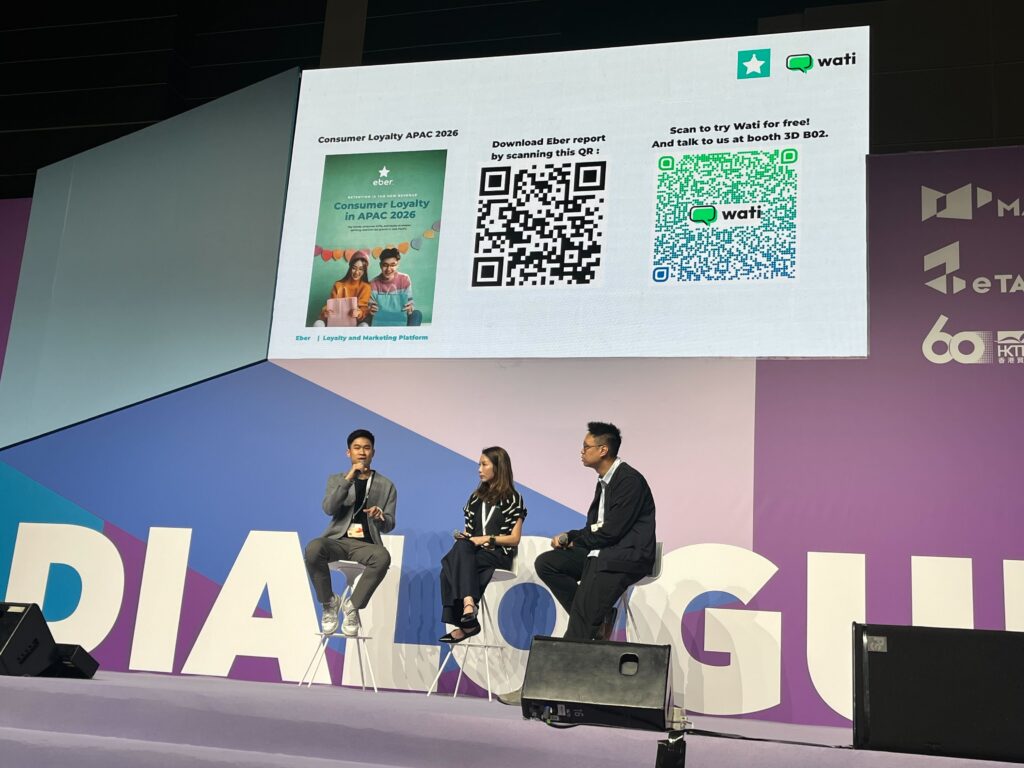
On 19 March 2026, our team took the stage at the Hong Kong Convention and Exhibition Centre for a short but pointed conversation. The topic: how brands can connect the dots between loyalty data and real-time customer engagement to drive measurable revenue.
What followed was one of the more direct conversations we’ve had in a public setting.
About the session
The session ran from 5:00 to 5:20 PM as part of the main programme. Catherine Leung from Eber joined James Chan from Wati and Ar Shek from OMP for a fireside chat format, covering how brands can connect the full customer journey from awareness through to retention.
Twenty minutes. Three perspectives. One clear thread running through all of it: most brands already have the data they need to drive better results. They just aren’t connecting it fast enough.
The number that stopped the room
11.7%
Abandoned cart recovery rate
0.34%
Abandoned cart recovery rate
Source: Figures shared by speakers at the Eber × Wati fireside chat, MarketingPulse 2026, Hong Kong Convention and Exhibition Centre, 19 March 2026.
That’s 34x. And the gap isn’t really about channel preference. It’s about timing and context. The customer who abandoned a cart is still deciding. What determines whether they come back is whether you respond before the moment closes.
Email, by design, is slow. WhatsApp is immediate and personal. But the real unlock is connecting the trigger, loyalty data that knows what the customer did, to the message that responds to it in real time.
Speed isn’t a nice-to-have. Every hour between intent and response is revenue walking out the door.
Three things we took away from the stage
01. Customers expect instant, not eventual
The standard has shifted. A response that arrives tomorrow isn’t a response. Brands that still operate on batch schedules are losing to brands that operate on triggers.
02. WhatsApp is a revenue channel, not a support channel
The session made this clear. Cart recovery, reward notifications, re-engagement flows, these aren’t customer service conversations. They’re revenue moments. The channel just happens to be WhatsApp.
03. Personalisation only works when the data is connected
Generic automation performs poorly not because customers ignore it, but because it arrives at the wrong time with the wrong message. Contextual, behaviour-based messaging wins. And that requires your loyalty data and your messaging layer to actually talk to each other.
Two layers. One revenue loop.
The fireside chat wasn’t a product demo. But it did illustrate what happens when two complementary tools are genuinely connected.
EBER
Intelligence layer
- Loyalty and points engine
- Customer lifecycle data
- Behavioural segmentation
- Trigger logic and rules
WATI
Execution layer
- WhatsApp Business API
- AI-powered conversations
- Real-time message delivery
- Two-way engagement flows
Eber knows what the customer did. Wati responds to it. The result is a loop that turns passive loyalty data into active revenue, without adding operational complexity.
The data is already there.The question is whether it’s connected.
Most businesses already have loyalty data. Most already have a messaging tool.
The gap isn’t tooling. It’s the connection between them and the speed at which that connection fires.
That’s what the conversation on stage was really about. And it’s what we’re built to solve.
Want to see how Eber connects loyalty data to real-time customer engagement?
Stay close to what we’re learning from partners, or explore how we work together:
Get event recaps, product learnings, and partner insights from across the ecosystem.
Have a question or want to explore a potential collaboration?
Leave your details and we’ll reach out.