Why Your Loyalty Portal Pages Take So Long to Update (And How to Fix It) Product Update · Portal Pages Why Your …

There's a point in every growing loyalty program where "just give them access" stops being a workable answer. Here's how role-based access control lets you scale across outlets fast, without over-sharing sensitive member data.

There's a point in every growing loyalty program where "just give them access" stops being a workable answer.
A new outlet opens. A marketing hire joins. An operations manager needs to pull reports but shouldn't be touching campaign settings. A store supervisor needs to look up member details but definitely shouldn't have access to your full member database.
At small scale, managing access user-by-user feels fine. But as your loyalty team grows — across roles, outlets, and functions — that approach breaks down fast. Things get missed. People end up with more access than they need. And when something goes wrong, it's hard to trace what happened and why.
Role-Based Access Control, or RBAC, is how you solve this — and in Eber, it's a Scale-tier feature, available alongside Audit Log and SSO.
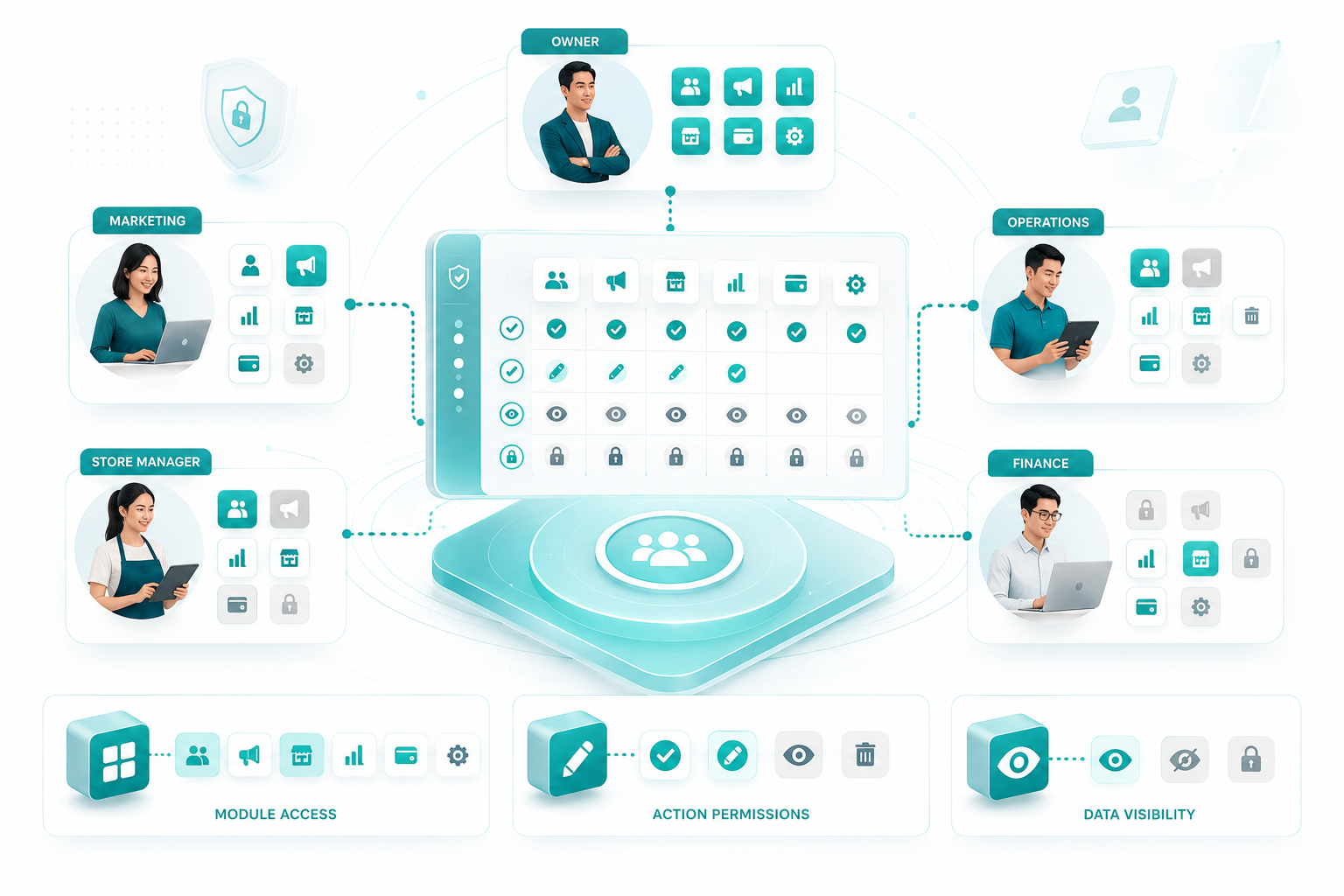
RBAC lets you define access by responsibility rather than by individual. Instead of configuring permissions for each person one at a time, you create roles — Owner, Marketing, Operations, Store Manager, Finance — and define what each role can access, what they can do, and what they can see.
When someone new joins, you assign them a role. They get exactly the access that role is designed for. No more, no less. In practice, this means controlling three things.
Which parts of the platform a role can open at all. A store-level role might have access to member lookup and transaction history, but not campaign creation or bulk exports.
What a role can do within the modules they can access. Viewing a member profile is different from editing it. Running a report is different from deleting data. RBAC distinguishes between these.
What sensitive information a role can actually see. Combined with field-level masking, you can ensure that roles which don't need to see full contact details, ID numbers, or financial data simply don't — even if they're in the same module.
For businesses running across multiple locations — a restaurant group, a retail chain, a hotel brand — RBAC becomes operationally essential.
Store staff need to serve customers efficiently. They don't need access to group-level analytics, campaign tools, or other outlets' member data. Regional managers need visibility across their cluster, but not necessarily across the whole organisation. Corporate admins need full access to configure, audit, and manage the platform.
Without RBAC, you're either over-sharing — giving people more access than they need, which increases risk — or under-sharing — locking people out of things they legitimately need, which slows down operations. RBAC lets you get it right.
| Level | Who | Access |
|---|---|---|
| Store | Front-line staff | Member lookup and transaction history for their own outlet only. No group analytics, campaign tools, or other outlets' data. |
| Cluster | Regional managers | Visibility across their own cluster of outlets, without full organisation-wide access. |
| Group | Corporate admins | Full access to configure, audit, and manage the platform across every outlet and role. |
This is the same operational reality behind Eber's work with ALL IT Hypermarket. Unifying retail and online rewards into one paid membership program across every outlet and its online storefront meant frontline staff, regional teams, and head office each needed the right — and only the right — level of access to run the program smoothly day to day.
See how Role Based Access, Audit Log, and SSO work together on Eber's Scale plan.
Talk to Us →Most conversations about access control focus on security. But RBAC delivers real operational value too.
When roles are pre-defined, new team members get the right access on day one. No back-and-forth about what they should or shouldn't be able to see. No manual configuration for every new hire.
When users can only take actions relevant to their role, the surface area for mistakes shrinks. A store manager who can't edit campaign settings can't accidentally break one.
When roles are documented and structured, internal reviews and audits become straightforward. You can answer "who has access to what, and why?" without digging through individual account configurations.
"Control doesn't have to slow you down. Designed well, it's what makes growth sustainable."
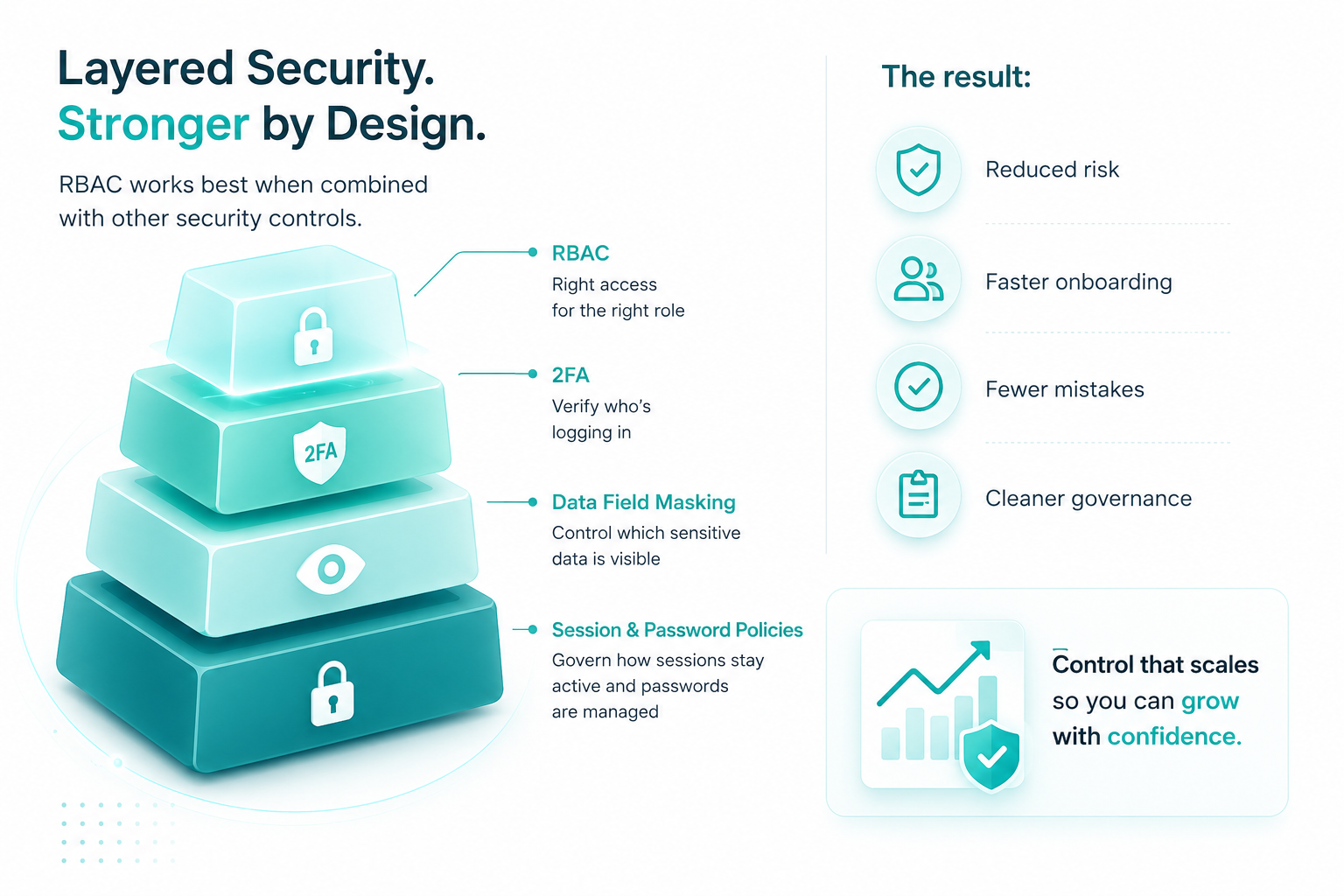
Eber Security & Platform TeamRBAC doesn't operate in isolation. In Eber, it sits alongside a set of controls that reinforce each other:
Setting up roles well at the start saves significant cleanup later.
| Principle | Why it matters |
|---|---|
| Small set of roles | Easier to maintain than mirroring the org chart exactly. Four to six well-defined roles beat twenty granular ones. |
| Operational vs. administrative split | Keeps day-to-day work (lookups, redemptions, reports) separate from platform configuration and bulk exports. |
| Quarterly review cadence | Access stays current as outlets open and teams restructure. |
| Documented role intent | Speeds up onboarding, audits, and future updates — knowing what a role is for, not just what it can do. |
Scaling a loyalty team shouldn't mean choosing between speed and safety. Role-based permissions let you do both: give people exactly what they need to move fast in their area of responsibility, while keeping sensitive member data and configuration tools in the right hands.
Control doesn't have to slow you down. Designed well, it's what makes growth sustainable.
Get a walkthrough of Eber's Scale plan, built for multi-outlet teams.
Get a Demo →Learn more about how Eber handles access control and team management at eber.co/security. See Role Based Access alongside Audit Log and SSO on the Scale plan, or read how ALL IT Hypermarket unified rewards across retail and online.

Why Your Loyalty Portal Pages Take So Long to Update (And How to Fix It) Product Update · Portal Pages Why Your …

Identity Retention: Why Your Best Customers Stop Comparing The Eber Show · Identity Retention Identity Retention: Why Your Best Customers Stop Comparing …

The Eber Show · Retention Playbook Three Categories, Three Conversations, One Retention Principle Between July and August we recorded three …